Road sign quiz: practise Swedish signs for the test
Reading about signs is not the same as being able to use them. This guide is about practice: how to quiz yourself on Swedish road signs until the meaning and the required action come to mind together.
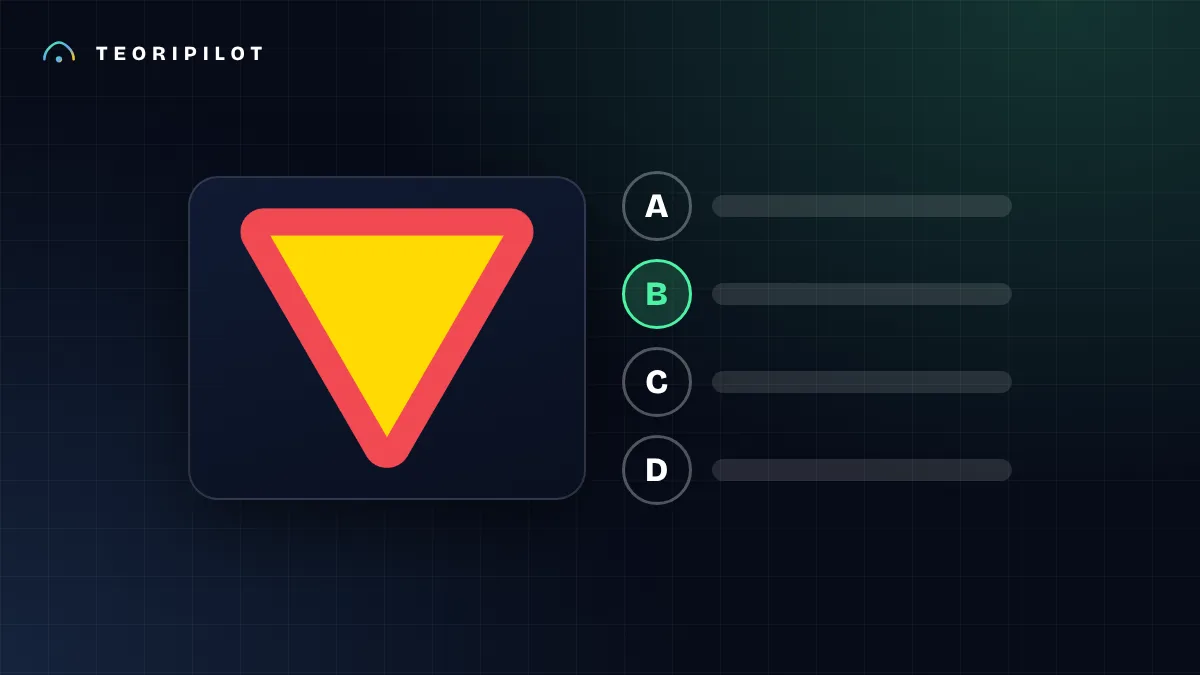
Practice, not just a list
Our guide to how to learn road signs explains how signs, markings and signals fit together. This one is the practice companion: a method for testing yourself, and a quick tour of the sign groups to quiz on.
The theory test asks what a sign means and what you should do because of it. Practise both halves every time: “what is it?” and “what do I do?”.
The main sign groups to practise
Varningsmärken: warning signs
Triangular signs that warn about a hazard ahead. Ask: what is the risk, and how should my speed and position change? The warning signs are free in the sign library.
Väjningspliktsmärken: priority signs
Give way, stop and priority road signs have distinctive shapes. Ask: who must wait, and where exactly do I stop?
Förbudsmärken: prohibitory signs
Round signs that forbid something, such as entering, overtaking or exceeding a speed. Ask: where does the ban start and where does it end?
Påbudsmärken: mandatory signs
Round blue signs that require a direction or behaviour, for example a direction you must follow or a path for certain users.
Anvisningsmärken: instruction signs
Signs that tell you how the road is arranged or what is permitted, such as a one-way street or a pedestrian crossing. Ask: what does this change for me and for others?
Lokaliseringsmärken: direction and information signs
Signs that show destinations, services and places. They are less about rules, but you should recognise their purpose.
Tilläggstavlor: supplementary plates
Plates below a sign that limit or explain it, for example to a time, a vehicle or a distance. Always read them together with the sign above.
A self-quiz you can do anywhere
- Cover the name and describe the sign’s shape, then say its group. If the group is wrong, the meaning will probably be wrong too.
- Question: a prohibition sign has a plate showing certain times. When does the ban apply? Answer: only during those times.
- Question: you see a warning sign for a hazard ahead. Does it tell you to stop? Answer: not by itself. It tells you to be prepared and adapt your speed.
- Question: a road marking and a sign seem to say different things. What do you do? Answer: check which one applies in the situation and follow the rule that governs it; read the whole environment before deciding.
A simple weekly routine
- Day 1: learn one group (for example warning signs) in the sign library.
- Day 2: quiz yourself on that group from memory, then check.
- Day 3: add the next group and mix it with the first.
- Day 4 onward: practise situations in lesson 38 and the first practice test.
- Repeat the groups you got wrong first. Short, frequent sessions beat one long evening.
Common sign-practice traps
Don’t rely on colour alone, because several signs share colours but mean very different things. Pay attention to the border, the shape and any symbol, and always ask where the sign applies. For more traps, see common mistakes on the theory test and the priority rules. Official descriptions of each group are on Transportstyrelsen’s page about road signs.
A five-step check for any sign in a question
Using the same five steps in every practice question turns sign knowledge into a habit that works under time pressure.
- Name the group: warning, priority, prohibition, mandatory, instruction, direction or plate.
- Say what the sign means in your own words.
- Decide where it applies: from the sign to the next end sign or junction, or only for a stated distance.
- Check for a supplementary plate, a road marking or a signal that changes the situation.
- Decide the action: slow down, give way, stop, avoid a manoeuvre or simply continue with care.
Frequently asked questions
How do I learn Swedish road signs fast?
Learn them in groups, quiz yourself from memory and always connect the sign to the action it requires. Short daily sessions work better than one long one.
What are the main groups of Swedish road signs?
Warning signs, priority signs, prohibitory signs, mandatory signs, instruction signs, direction and information signs, supplementary plates, plus road markings and traffic signals.
Are there free sign practice questions?
TeoriPilot’s warning signs are free in the sign library, and the first practice test is free. The rest of the library and the other tests need a pass.
Do I need to know every sign for the theory test?
Trafikverket does not publish a list of the signs that appear. Focus on understanding each group and the most important signs and markings.
Can I practise signs without paying?
Yes, to a point. The warning signs in the sign library and the first practice test are free, which is enough to try the method before deciding on a pass.
Open the free warning-sign library
Related in the course
Keep learning
- Swedish road signs: learn signs, markings, signals
- Common mistakes on the Swedish theory test
- Study Swedish driving theory in a week: 7-day plan
Sources
Facts checked against the sources on 2026-10-15. Always check the authorities’ pages for current rules.